
Reditus in Urbem – Latin on the Direct Method: Short Program in Rome
Reditus in Urbem – Come back to the Aeternal City
Three weeks of Living Latin in Rome
The short program is an in-depth and engaging study experience: students are going to learn speaking and writing Latin with a new methodological approch; they also share their daily life. In fact, the most fascinating aspect of this travel opportunity in Rome is precisely the sharing of both academic activities and everyday life at the college, which is housed in a large villa with a spacious garden and wide lawns.
Overview
Students will study Latin grammar and vocabulary through the active use of both written and spoken Latin. In this way, they will acquire a learning method for classical languages that contributes to the expansion of methodological diversity and plurality in this field. They will experience living and studying together at the Italian Institute of Classical Studies, near the city centre of Rome.
In this shared-living context, the practice of learning Latin via the direct method will be encouraged and guided. Students will work on several key aspects of Latin morphology and syntax, starting from a carefully selected text. As a result, they will learn a substantial portion of classical literary vocabulary. In addition, a series of lectures—held in English—will be offered on significant themes in Roman culture. These topics will be addressed through the study of essential authors of the history of classical Latin literature.
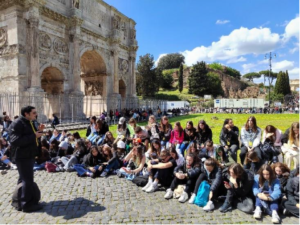
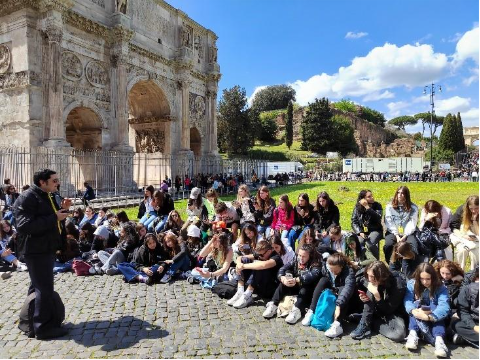
Consequently, the trip to Rome offers an extraordinary opportunity to experience direct and immediate contact with the legacy of this great civilisation. Alongside classroom lessons, excursions will be organized with an archaeological, historical and artistic focus. These outings will be conducted in English; however, there will also be opportunities to take part in guided walks conducted in Latin, reading excerpts of literature in the original language directly at the sites being visited.
DOWNLOAD REDITUS
The Italian Institute of Classical Studies has developed a new methodology which through the direct use of the language allows students to acquire the ability to read and completely understand a text in Latin or Ancient Greek in the original language, in a quick and reliable way. In the IISC courses, language is learnt gradually, through the direct method both by the teacher and the students: grammatical rules are given in a context which allows understanding of their principles and possible applications; learning of vocabulary takes place in a linguistic context which guarantees understanding and memorization of words.
The choice to actively employ Latin and Ancient Greek in the classroom is a tool for a deeper and sounder acquisition of the language. The goal is to bring literary texts within the grasp of the students.
The active and direct use of Latin and Ancient Greek as an instrument for language acquisition is not, as many might think, a modern invention. The direct method has indeed been used for teaching Latin and Ancient Greek almost continually from Roman times to the modern age.
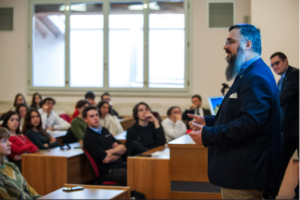 Now in the 21st century, our IISC professors are combining the teachings of 20th century scholars, the Fathers of pedagogy and the Masters of the Renaissance, from Comenius to Vives, from Corderio to Erasmus. They continue to passionately develop the IISC method, providing Classics scholars with the same pedagogical toolkit as their esteemed predecessors.
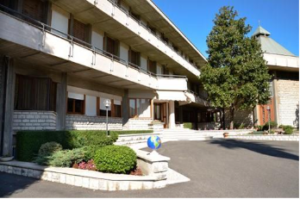 Students may be accommodated at the Guesthouse Mater Mundi, in Via Lorenzo Rocci 64, Rome.
Students are given:
- single or double bedroom with private bathroom;
- study rooms;
- complete pension, which includes breakfast, lunch and dinners (first dish, second dish, side dish, fruit, bread, drinks);
- laundry service (not included in the fees).
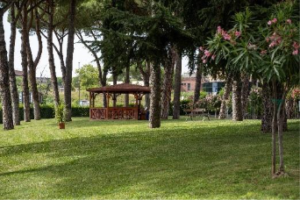 The Guesthouse has also an outside garden and is served by public transport. In the area, there are also many bars, restaurants and other services.
Those who wish to be accomodated in a single bedroom (rather than in a double room) may send a request and pay an additional charge of € 18 per day (€ 380 for the whole month).
Students can arrive on Sunday morning November 22 and bedrooms will be available from 4.00 pm.
The short program ends on Saturday December 12 with a “goodbye” dinner!
The check-out is scheduled for Sunday December 13.
Please note that if you wish to arrive earlier and/or leave later, you need to contact the Guesthouse Mater Mundi at info@casamatermundi.it
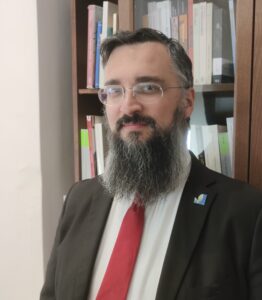
Instructor

- Start/end dates: 2026 November, 23 - December, 11
- Teaching method: in person
- Schedule: from Monday to Friday (+ field-trips in the weekend)
- Duration: 50 hours
-
Structure:
Latin language: 32 hours
Roman Culture: 8 hours
Field Trips: 10 hours - Location: Guesthouse Mater Mundi in Via Lorenzo Rocci 64, Rome
- Titles released: 12.5 UoM points
- Language Latin / English